

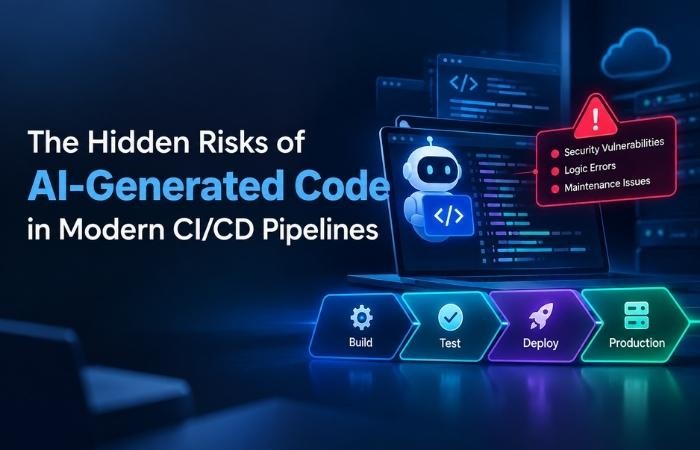
The utilization of artificial intelligence coding assistants has shifted from experimental autocomplete scripts to an integrated component of the software development lifecycle. Enterprise telemetry reflects the scope of this transformation. Studies show that developers employing these solutions get a 55% boost in the speed that they complete their work. But this velocity of output creates architectural friction, leaving teams open to AI-generated code risks.
According to GitClear’s research of over 153 million lines of code created over the years, code churn has increased dramatically, with a considerable loss in code reuse compared to pre-AI baselines. Once machine-driven contributions that have not been vetted get into automated deployment routines, speed becomes operational risk. Engineering teams should include explicit validation frameworks into their continuous integration infrastructure to avoid technological debt and deployment problems.
Decentralized Vulnerabilities: Code Defects and Supply Chain Hazards
AI models operate on probabilistic token prediction rather than structural or semantic comprehension. Because they are trained on public, historically flawed repositories, managing AI-generated code risks in CI/CD pipeline deployments requires addressing specific technical defects.
Outdated Dependency Topologies
Automated assistants lack real-time visibility into an organization’s internal dependency trees or private registry updates. A model may generate code utilizing outdated package versions containing known Common Vulnerabilities and Exposures (CVEs), quietly reintroducing patched vulnerabilities into the codebase.
Package Hallucination and Slopsquatting
Large language models regularly generate syntactically correct code blocks that import non-existent open-source packages or third-party libraries. Malicious actors actively monitor open-source ecosystems to identify these recurring, model-generated package names. Attackers can register malicious payloads under these specific hallucinated names, tricking environments into fetching compromised code during the build process and escalating the danger of AI-generated code in CI/CD systems.
License Non-Compliance
Automated models can accidentally reproduce exact snippets of copyleft or restricted open-source code, lacking the necessary information to attribute its source. Organizations face substantial legal liability and license non-compliance if these pieces are put into production without verification.
Structural Code Degradation
Automated assistants are very good at producing isolated, localized logic pieces but not good at mapping dependencies across huge, multi-tiered software structures. This constraint creates complicated abstractions, duplicated logic, and fragile integration points, which cause unexpected build failures and reduced pipeline predictability.
Hardening the Pipeline: Engineering Deterministic Guardrails
Relying on manual peer reviews to catch these defects creates an immediate engineering bottleneck. While platforms focus on AI-enhanced engineering redefining innovation across the development lifecycle, the immediate solution to these localized pipeline problems requires adding automatic, deterministic validation gates inside the deployment pipeline. These validation gates systematically remove structural errors and provide secure AI-generated code prior to compilation.

Taint Analysis and Advanced Static Scanning
Standard Static Application Security Testing (SAST) settings will need to be modified to accommodate the level of variance inherent in automated programming. Pipelines should be forced to validate AST tokens and perform data-flow taint analysis. This guarantees that all parameters created by automated components are checked before they can reach important system sinks, creating rigorous AI code security in the CI/CD pipeline infrastructure.
Software Composition Analysis (SCA) and Registry Verification
The execution step should include automated SCA screening to mitigate the risk of package hallucination. Build scripts should include automated search stages to compare each outgoing package dependency against validated public registries (e.g., npm or PyPI) and internal artifact repositories. The methodical approach to the DevSecOps AI code validation ensures that any unresolved or missing package references will immediately fail the build, avoiding discretionary resolution of external packages.
Automated Quality Gates and Churn Thresholds
Organizations must enforce quality gates with static analysis platforms such as SonarQube on all machine-assisted pull requests. These gates need to impose explicit code-complexity limitations (for example, cyclomatic complexity thresholds) and obligatory unit test coverage standards. If the pull request adds a lot of churn to the code without providing the same number of test cases, the pipeline should immediately stop the merge.
The Evolution of Engineering Verification
The rise of automated development technologies does not reduce the necessity for human engineering, but rather changes the very heart of its concentration. Teams must evolve from manually defining rules line by line to systematically governing them, becoming architects who build, monitor, and tune automated guardrails.
Modern software testing methodologies depend on human context and a deep sense of structural intuition to generate the automated configurations that assure application stability. Automated generation technologies increase raw output velocity, but human verification provides the strategic guardrails that make production systems secure, dependable and maintainable. Finding this balance means that engineering teams may enjoy the benefits of development speed without sacrificing software safety.

