

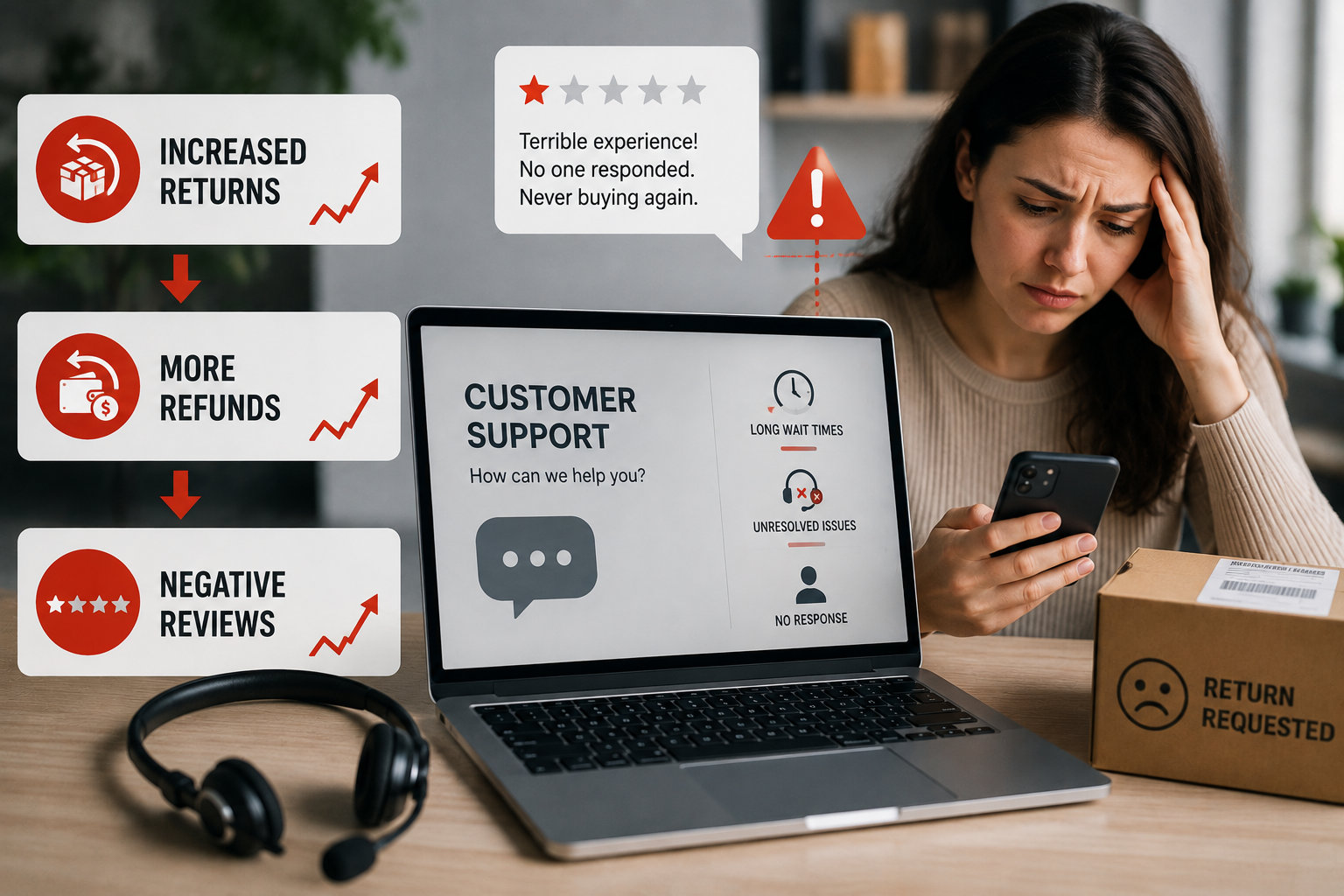
Are your customer support operations protecting your brand image and revenue or negatively affecting them?
In eCommerce, customers often seek help before deciding whether to keep a product. Unanswered product questions, unclear delivery communication, incomplete troubleshooting, and unresolved complaints can turn manageable issues into return requests, refund claims, marketplace escalations, negative reviews, and lost repeat purchases.
Moreover, the financial impact extends beyond the refunded order value. Poor support increases reverse logistics costs, affects marketplace account health, weakens conversion, reduces advertising efficiency, and lowers customer lifetime value.
For eCommerce sellers, the real challenge is not simply responding to more tickets. It is building a proactive, resolution-focused support workflow that removes customers’ uncertainty, prevents avoidable returns, strengthens customer retention, and protects margins.
How eCommerce Customer Support Gaps Drive Returns, Refunds, and Negative Reviews
1. Delayed Pre-Sale Product Assistance
Buyers frequently contact support before placing an order to verify sizing, compatibility, specifications, warranty coverage, or product suitability. When these inquiries remain unanswered, many shoppers abandon the purchase, and a few proceed based on assumptions. These assumption-led purchases are more likely to result in expectation mismatches, avoidable returns, refund requests, or “not as described” complaints.
2. Fragmented Customer Service Channels
Customers may contact a business through marketplace messaging support, email, live chat, or social media. Without a centralized support system, agents repeat questions, provide inconsistent responses, and delay resolution. This can leave the buyer frustrated, making them more likely to request a refund, initiate a return, escalate the issue through the marketplace, or leave negative feedback.
3. Inadequate Product-Specific Technical Support
Customers purchasing electronics, home appliances, automotive parts, or other technically complex products often require assistance with installation, configuration, compatibility verification, or troubleshooting. When support teams lack product expertise, diagnostic tools (such as product documentation or troubleshooting guides), or clear escalation paths, technical issues remain unresolved. As a result, customers are more likely to request a refund rather than continue troubleshooting.
4. Delayed Resolution of Complex Support Cases
Some cases require input from the seller, the logistics provider, the warranty team, or a technical specialist. For example, a damaged appliance complaint may require warranty eligibility checks and technical assessment before the seller can approve a replacement or refund. When support teams fail to route these cases promptly or maintain ownership through resolution, customers face repeated follow-ups and longer wait times. These delays can increase the likelihood of refund requests, marketplace claims, or negative reviews.
5. Insufficient Support Across Time Zones
eCommerce businesses often serve customers across multiple time zones, while support teams operate within fixed regional hours. As a result, inquiries submitted during evenings, weekends, or promotional periods may remain unanswered for extended periods. Delayed assistance can prolong unresolved delivery or product issues, increasing the likelihood of refund requests, returns, or negative reviews.
6. Unresolved “Where Is My Order?” (WISMO) Inquiries
Customers raise WISMO inquiries when tracking stops updating, an order misses its expected delivery date, or a package appears lost or misdelivered. These inquiries require a clear explanation of the order status, the steps being taken, and the available resolution options. When customer support responds slowly, provides vague updates, or fails to follow through, the inquiry remains unresolved, and customer uncertainty increases. These delivery exceptions lead to Item Not Received claims, refund requests, chargebacks, marketplace escalations, or negative reviews.
7. Automated Support Without Clear Escalation
Automated chatbots can resolve routine inquiries, but complex issues often require human support. When customers receive repetitive responses or cannot reach an agent, the issue remains unresolved, and leads to dissatisfaction. Customers may then abandon the support process, request an immediate refund, or leave negative feedback about the service experience.
The Cost of Poor Customer Support Management in eCommerce
1. Margin Erosion and Reverse Logistics Costs
- Return Handling and Processing Costs: When poor customer support increases avoidable returns, sellers incur additional expenses for return shipping, inspection, grading, repackaging, inventory disposition, and applicable marketplace or 3PL return processing fees.
- Loss of Resale Value: Returned products may no longer qualify for resale at full price due to open packaging, missing components, handling damage, or delayed restocking. Moreover, seasonal and trend-dependent SKUs may also require markdowns when the return cycle extends beyond peak demand.
- Refund and Compensation Costs: Support teams may offer returnless refunds, replacement products, gift cards, or goodwill credits when recovering and processing the returned item would cost more than its resale value. Although these options may reduce reverse logistics costs, they still reduce the profit margin on the original order.
2. Marketplace Account Health Risks
Marketplaces assess sellers against defined account health and seller performance metrics. Poor customer support can negatively affect these metrics when unresolved buyer issues result in negative feedback, payment chargebacks, or buyer protection claims.
On Amazon, for instance, the Order Defect Rate (ODR) is affected by negative seller feedback, A-to-z Guarantee claims that count against the seller, and service-related credit card chargebacks. For example, if a seller does not resolve a damaged-item complaint, the buyer may leave negative seller feedback or file an A-to-z Guarantee claim. Amazon requires sellers to maintain an ODR below 1%. Exceeding this threshold may put the seller’s selling privileges at risk.
3. Conversion Rate and Customer Acquisition Costs
- Conversion Rate Decline: Negative product reviews and seller feedback highlighting delayed responses, unresolved complaints, or poor issue resolution can reduce buyer confidence before purchase. This results in low conversions affecting profit margin.
- Reduced Advertising Efficiency: Poor customer support may lead buyers to leave negative product reviews that mention unresolved complaints or ineffective issue resolution. These reviews can discourage shoppers who arrive through paid campaigns. When paid campaigns convert fewer shoppers, cost per acquisition rises and return on ad spend declines.
4. Customer Retention and Service-Induced Churn
- Lower Customer Lifetime Value: A poor support experience can reduce repeat purchases even when the product itself meets expectations. This reduces the customer lifetime value and overall profitability from each buyer.
- Service-Induced Churn: Customers with a poor support experience may stop purchasing without leaving a negative review or offering a clear explanation. When businesses analyze customer support data separately from repeat-purchase behavior, they may attribute declining retention to pricing, competition, or product quality instead of recognizing customer support as the underlying cause.
- Higher Customer Reacquisition Costs: When repeat purchases decline, businesses must acquire more new customers to maintain revenue. This increases reliance on paid advertising, discounts, and remarketing campaigns rather than generating a larger share of revenue from repeat customers.
The Framework: How to Set Up an Efficient Customer Support Workflow
1. Centralize Customer Support Channels
Connect marketplace messages, email, live chat, phone calls, and social media messages through a centralized help desk or ticketing platform. This allows agents to access previous conversations, order details, and ticket status before responding. A centralized system also reduces repeated responses, missed inquiries, and inconsistent communication across channels.
2. Prioritize and Route Customer Inquiries
Configure the customer support ticketing platform, such as Zendesk, Gorgias, Freshdesk, Salesforce Service Cloud, or a marketplace-integrated help desk, to classify inquiries by contact reason, urgency, order status, product category, language, and required expertise. Routing rules should then assign each ticket to the agent or team best equipped to resolve it. This ensures that technical, delivery, payment, and warranty-related inquiries reach agents with the appropriate knowledge and authority.
3. Define Service Level Agreements by Channel
Set first-response and resolution-time targets for each customer support channel. Live chat generally requires faster responses than email, while marketplace messages must comply with the platform’s response requirements. Review these targets against ticket volumes, seasonal demand, product launches, and promotional campaigns to ensure the support team can consistently meet them.
4. Standardize Resolution and Escalation Workflows
Specify which actions frontline agents can complete independently, including replacements, refunds, credits, or policy exceptions. Define the conditions that require specialist or managerial approval. Each escalation should include the relevant case details and a target response time.
5. Create a Centralized Product Support Repository
Provide customer support agents with current product specifications, size guides, compatibility information, warranty terms, return policies, and troubleshooting guides. Maintain a centralized repository of the required documentation that customer support agents can quickly access during customer interactions. Repurpose relevant information into customer-facing FAQs, setup guides, and help-center articles to help customers resolve routine inquiries through self-service.
6. Integrate Automation with Human-Led Resolution
Use automation to acknowledge inquiries, assign ticket tags, provide order-status updates, recommend relevant troubleshooting guides, and route tickets to the appropriate team. Chatbots can handle routine questions, but a specialist is required when an issue demands judgment, investigation, or policy approval.
7. Align Support Coverage with Demand Patterns
Customer support demand changes across time zones, weekends, seasonal sales, and promotional campaigns. Use historical ticket volumes and projected order demand to identify when inquiry volumes are likely to rise. Adjust staffing before and after peak sales periods to manage increases in order-status inquiries, delivery issues, returns, and refund requests.
Where in-house teams often struggle to maintain extended-hour coverage or scale quickly, an eCommerce customer support partner can provide trained agents, flexible staffing, multichannel coverage, and SLA-based workflows. This outsourcing model helps clear routine inquiries and ticket backlogs while reducing recruitment, training, infrastructure, tooling, and management overhead.
8. Measure Support Performance and Business Impact
Track operational metrics such as first-response time, average resolution time, ticket backlog, SLA compliance, First Contact Resolution, repeat contact rate, and Customer Satisfaction. Review these metrics alongside return rates, refund rates, negative seller feedback, and repeat-purchase behavior. This combined view shows whether support teams are resolving customer issues effectively or merely processing a higher volume of tickets.
Turn Support into Margin Protection with a Resolution-First Operating Model
Treat rising returns, refunds, marketplace claims, and negative reviews as signals of unresolved customer issues. Review support interactions alongside product, order, fulfillment, and return data to identify the underlying causes. Effective eCommerce customer support diagnoses operations across three areas:
- Response Timeliness: Do agents provide accurate assistance before uncertainty leads to a return request, a refund claim, or a negative review?
- Resolution Capability: Can agents offer troubleshooting, replacements, exchanges, or clear next steps without unnecessary delays?
- Root-Cause Reporting: Do support teams share recurring issues with the teams responsible for catalog management, fulfillment, packaging, policies, or technical documentation?
Together, these three areas reduce support friction by improving response speed, strengthening resolution capability, and preventing recurring customer issues. The next step is to quantify how support performance affects return rates, marketplace account health, and customer retention. This makes customer support a measurable business function rather than an isolated service operation.
Author Bio: Ravi Kant is the Vice President of the eCommerce and Photo Editing Division at SunTec India. With over two decades of global experience, he spearheads large-scale digital commerce initiatives that drive operational excellence and measurable ROI for global businesses. His expertise spans eCommerce strategy, digital transformation, and data-driven performance optimization.

