

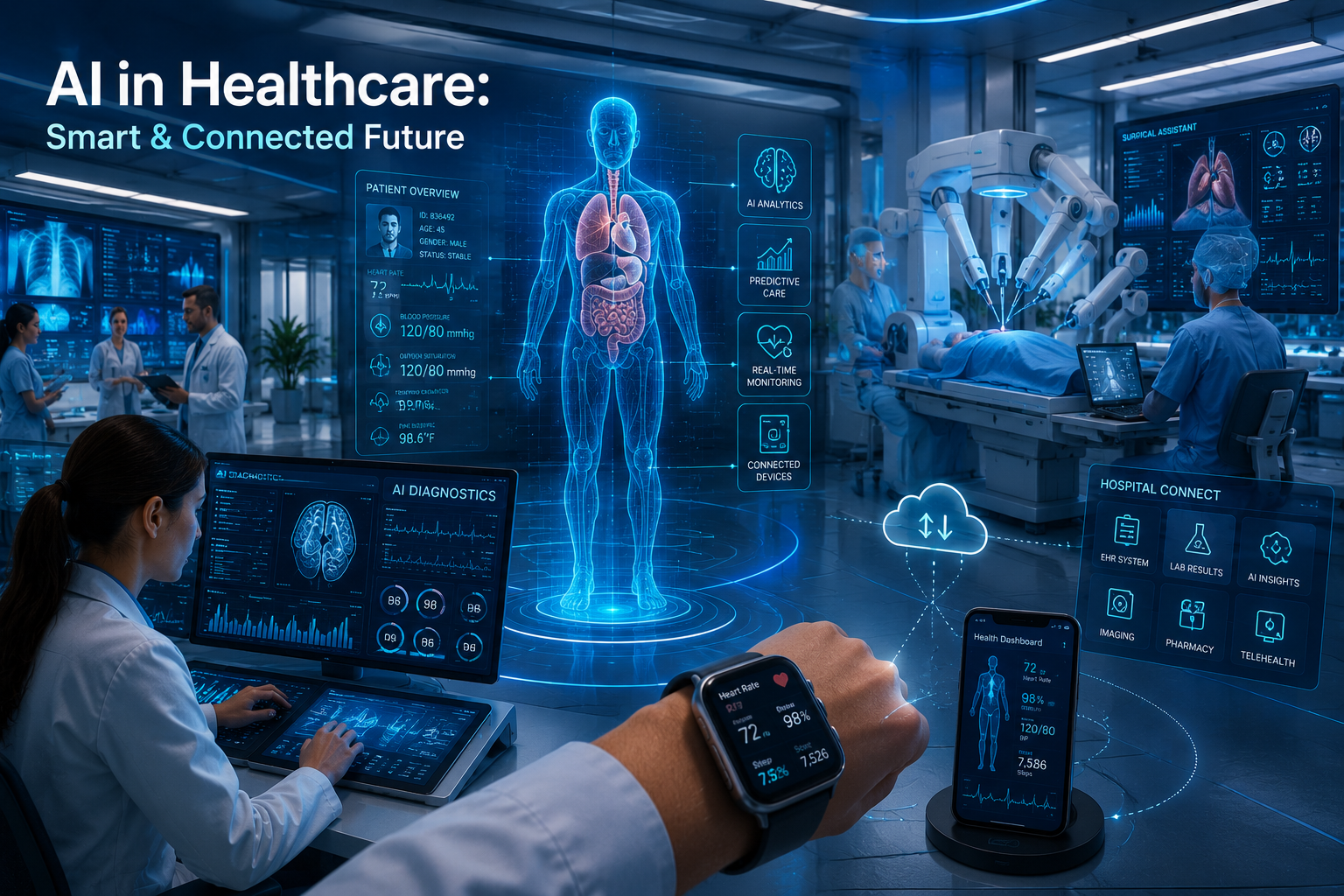
AI in Healthcare is no longer just an idea; it is a reality actively transforming the delivery, documentation, monitoring, and personalization of healthcare. The use of artificial intelligence in diagnosis, remote patient monitoring, and even hospital operations is proving its value by making healthcare systems more intelligent and connected.
According to Grand View Research, the global AI in healthcare market is expected to reach over $USD 505.59 billion by 2033,, driven by rising demand for predictive analytics, intelligent diagnostics, and connected healthcare infrastructure.
As the healthcare industry faces increasing patient demand and staffing shortages, among other challenges, AI and digital health solutions are helping fill key gaps. They are not going to replace clinicians anytime soon; rather, they will assist healthcare professionals by improving access to information and analytics.
The Shift Toward Connected Care
Historically, healthcare has been a sector that worked in silos. The medical history, laboratory test results, radiology, pharmaceuticals, and other monitoring systems were often isolated. This made it hard for clinicians to see the whole picture of a particular patient’s health. In today’s world, AI solutions are used to consolidate fragmented information sources into a cohesive structure.
With the advent of advanced, smart healthcare solutions, machine learning and automation technologies are leveraged to facilitate seamless data integration. This enables medical practitioners and the care team to gain better insights into patient treatment.
Here’s where the concept of healthcare digital transformation goes beyond being merely a buzzword. It takes on meaning as a method of creating an environment that is both more efficient and more responsive. By leveraging artificial intelligence in hospitals, one can identify trends in extensive clinical datasets and draw conclusions that would otherwise be missed by human operators.
AI’s Role in Diagnosis
One way AI technology is commonly applied in healthcare is for diagnosing conditions. AI can scan medical images and patient data at incredible speeds to detect abnormalities. Within radiology, for instance, AI could be used to identify unusual features in an MRI scan, among other applications.
However, it does not imply that AI is replacing clinical judgment. Instead, it works more as another set of eyes. With many hospitals operating under heavy workloads, having an additional pair of eyes could help prevent potential lapses. Moreover, artificial intelligence makes it easier to identify trends in patient history records.
For such entities, it is an excellent argument for developing software that matches their processes. Generic solutions may not work well when handling the specific requirements of a hospital’s workflow. Software developed to meet the organization’s needs can integrate all aspects of artificial intelligence, electronic health records, and reporting tools into a single interface.
Personalized Treatment and Care
The healthcare industry is shifting from the one-size-fits-all approach to treatment. AI is contributing to the development of personalized medicine by assisting doctors in designing treatment plans tailored to an individual’s data, such as medical history, lifestyle, biomarkers, and past experiences.
The use of predictive analytics would also help identify patients who might experience complications during treatment and thus require intervention by health care professionals in advance. This will also facilitate better resource utilization as the appropriate patient receives the most suitable treatment.
This translates into the AI technology’s ability to enable hospitals to shift their focus from reactive to proactive care. As a result, hospitals will be able to prevent situations from escalating by making decisions based on data analytics.
Remote Monitoring and Wearables
Another crucial component in the evolution of smart healthcare is remote monitoring. This means monitoring vital signs and any signs from afar using wearables and mobile health applications. Analysis of the technology of this information gives insight into crucial matters.
This becomes very important for elderly people, patients suffering from chronic diseases, and those recovering from surgery. Such remote monitoring allows for minimizing unnecessary hospital visits and enables timely intervention by healthcare professionals in the event of complications. In addition, remote monitoring allows individuals greater flexibility in managing their health.
With integrated systems that leverage healthcare software development services, information collected by wearables can be seamlessly incorporated into patient records. As a result, healthcare services become even more patient-centric and efficient. Interoperability becomes a key element in developing smart healthcare applications.
Smarter Hospital Operations
AI is also changing the operational side of healthcare. Hospitals and clinics deal with complex scheduling, staffing, billing, inventory, and documentation challenges every day. These processes can consume time and create bottlenecks if managed manually.
AI-based automation can support processes such as appointment scheduling, handling high-priority cases, estimating patient traffic, and managing resources efficiently. Administrative personnel would be able to allocate more effort to assisting patients and less to routine duties. Some AI systems could support even the documentation of clinical information.
Such an efficient system is important since health care not only involves providing treatment but also depends on the systems that facilitate the process. The use of a well-planned system increases efficiency, reduces waiting time, and improves coordination among different departments. When planning new systems, custom software development should be considered strategically.
Data, Privacy, and Trust
Despite its potential, the use of AI brings along many responsibilities. First of all, patient records are highly sensitive. Therefore, there are regulations related to their confidentiality and security, as well as the requirement to maintain the quality of the data used in machine learning algorithms. Furthermore, it needs to be constantly checked.
Trust is extremely important in healthcare, since both patients and specialists are supposed to rely on the information provided by tools. Inaccurate data integration and poor analysis may lead to incorrect recommendations. That is why, despite its advanced nature, AI still cannot replace humans.
In addition, model transparency is important in healthcare, as it presupposes that clinicians have clear explanations of the basis of each recommendation. Moreover, it facilitates further implementation, as staff members will work with the tools.
Building the Future Healthcare Stack
The development of AI applications within healthcare will depend significantly on their interoperability. The healthcare system, telemedicine platform, wearables, analytics software, and patient apps should work together seamlessly to help create a more coherent and intelligent healthcare sector.
In this sense, the relationship among AI, interoperability, and custom software development services leads to better outcomes. Contemporary healthcare platforms do not simply store electronic health records; they also provide solutions for diagnosing, treating, monitoring, and communicating across different phases of healthcare delivery.
Digital healthcare service providers, insurance companies, and healthcare startups should not overlook the potential offered by such systems and platforms. An appropriate architecture can improve patient outcomes and reduce long-term costs for healthcare organizations.
Conclusion
The use of AI in healthcare technology creates an environment where medical care will be more predictable, personalized, and interconnected. AI is making healthcare more responsive and resilient through AI-powered diagnostics, AI-based remote monitoring, enhanced healthcare operations management, and integrated healthcare recordkeeping.
Only the most proactive healthcare institutions see AI as a crucial component of a comprehensive digital strategy and invest in interoperable systems, reliable data management, and healthcare software development services. This is where smart and interconnected healthcare technology will lead us.

