

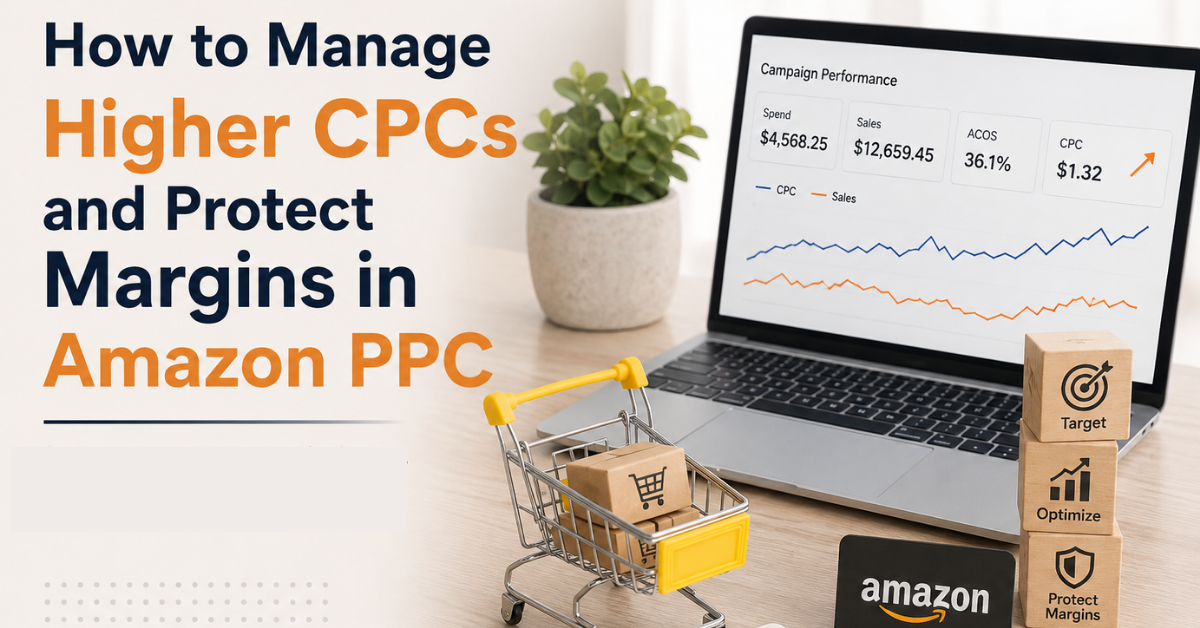
Latest industry reports and benchmarks indicate that Amazon CPCs have increased by 15–25% across several competitive categories, raising a critical question for sellers: How can they protect profit margins as the cost of paid traffic continues to rise?
Higher CPCs increase the cost of acquiring paid traffic and place additional pressure on contribution margin, particularly when conversion rates, order values, and product margins remain relatively stable. The challenge becomes more pronounced in categories where sellers must continue competing for high-intent search terms and premium placements to sustain visibility and sales momentum.
For sellers, the priority is not simply to reduce bids or withdraw from competitive auctions. It is to determine where higher click costs remain commercially viable, where advertising efficiency begins to weaken, and how campaign decisions should align with SKU-level economics.
Rising Amazon CPCs: Why Sellers Are Facing Higher Advertising Costs
1. Increased Competition Across Amazon Ad Auctions
As more third-party sellers, DTC brands, established consumer brands, and enterprise advertisers enter the Amazon marketplace, competition for high-intent search terms increases. This pushes CPCs higher, particularly for queries with strong conversion potential.
Competitive categories such as beauty, electronics accessories, supplements, and home products face greater competition around commercially valuable search terms. The number of high-visibility placements, including Top of Search, remains limited, so more advertisers are competing for the same positions and impression share.
Large consumer and enterprise brands can also sustain more aggressive bidding when visibility, category penetration, or market share is the campaign objective. As competition intensifies around these high-value queries and placements, bid levels increase and CPCs move higher.
2. Amazon Retail Media and Paid Advertising Placements
Amazon’s advertising ecosystem has evolved from marketplace search ads into a broader retail media environment where brands compete across multiple shopper touchpoints. Sponsored Products, Sponsored Brands, display, video, Amazon DSP, and off-Amazon placements have increased the number of advertisers competing for shopper attention across the purchase journey.
Sponsored Products have also expanded to premium sites, apps, conversational experiences, and creator content in supported markets [Source: Amazon]. As more advertisers use these placements through existing campaign settings, competition for clicks extends beyond Amazon-owned search inventory.
This wider distribution of ad demand can push CPCs higher, particularly in placements and audience segments where multiple advertisers target the same high-value shoppers.
3. Automated and Dynamic Bidding
Amazon’s dynamic bidding capabilities allow Sponsored Products bids to adjust in real time according to the likelihood of conversion. With Dynamic Bids – Up and Down, bids can increase or decrease by up to 100% based on performance signals associated with the individual auction.
Suggested bids, placement adjustments, and third-party bid automation also make campaign bidding more responsive to changes in performance and competition. As these capabilities become more widely used, bid levels can adjust more frequently around high-performing search terms and placements. Automated bidding does not create CPC inflation on its own, but it can accelerate how quickly changes in competitive demand are reflected in auction prices.
4. AI-Powered Amazon Advertising Placements
Sponsored Products prompts and Sponsored Brands prompts now extend CPC-billed advertising into conversational shopping with Alexa for Shopping.
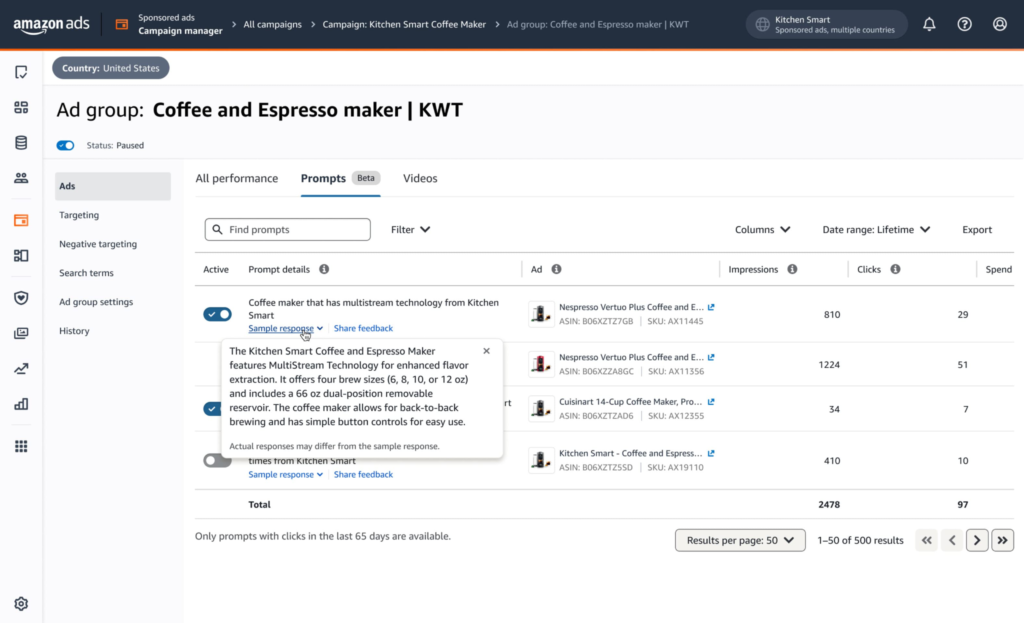
Eligible campaigns can automatically serve across these placements, adding new paid interactions beyond conventional search and product detail page ads. As advertiser participation grows across these AI-assisted placements, competition for clicks can increase, contributing to higher CPCs.
Amazon Advertising Costs: CPC Benchmarks Across Competitive Categories
| Category | Typical CPC Range | Why CPC Pressure Is Higher |
| Beauty & Personal Care | ~$1.20–$2.20+ | High advertiser participation and strong repeat-purchase potential increase competition for valuable search terms. |
| Health & Household | ~$1.10–$1.70 | High purchase intent and competitive product segments create stronger auction competition. |
| Electronics | ~$1.00–$1.50+ | Higher average order values support more aggressive bidding for conversion-focused traffic. |
| Supplements & Wellness | ~$1.30–$2.50+ | Commercially valuable keywords attract multiple brands competing for high-intent shoppers. |
| Home & Garden | ~$0.75–$1.40 | CPC varies based on product demand, seasonality, and category competition. |
| Sports & Outdoors | ~$1.00–$1.30 | Competitive keywords and seasonal demand can increase auction pressure. |
How Amazon Sellers Can Protect Margins Despite Rising CPCs
1. Set Break-Even CPC Thresholds by SKU
Determine how much each SKU can afford to pay for a click before advertising costs begin to reduce contribution margin. Sellers can calculate break-even CPC by multiplying profit per sale by the product’s conversion rate.
Use this threshold to evaluate whether current CPCs remain commercially viable at the SKU level. This provides a clearer basis for bid decisions than marketplace averages or Amazon’s suggested bid ranges. Recalculate the threshold when selling price, Amazon fees, fulfillment costs, promotions, or conversion rates change, since each variable affects how much the SKU can profitably absorb in advertising cost.
2. Improve Campaign Structure and Keyword Control
Separate campaigns by search intent, product type, and advertising objective so sellers can identify which targets can support higher click costs and which reduce margin.
Automatic campaigns can support keyword discovery, while manual campaigns let sellers allocate budgets to proven search terms. Manage branded campaigns separately from non-branded campaigns to maintain clearer performance benchmarks and greater control over where higher CPCs are acceptable. This separation also helps sellers assess whether branded spend is generating incremental sales or whether more budget should move toward category and non-branded targets with stronger growth potential.
3. Use Search Term Data to Improve Amazon PPC Efficiency
Search term reports show the actual customer queries driving clicks and conversions. Use this data to identify which queries continue producing sufficient sales at higher CPCs and which ones consume budget without delivering adequate conversions.
Move high-performing search terms into dedicated exact match campaigns for greater control over bids and budgets. Exclude search queries with weak relevance or poor conversion performance through negative keyword targeting. Refine broad and phrase match targeting when they repeatedly trigger expensive queries outside the intended search intent. This concentrates advertising spend on customer searches that can better support higher click costs.
4. Optimize Product Detail Pages to Improve Conversion Efficiency
Product detail page performance directly determines how much revenue sellers generate from paid traffic. A stronger conversion rate helps sellers turn more ad clicks into orders and improve the economics of higher-cost traffic.
Sellers should strengthen retail readiness by optimizing titles and bullet points, improving image quality, adding A+ Content, maintaining competitive pricing, keeping inventory available, securing Featured Offer eligibility, and building review strength. Stronger conversion performance helps offset higher CPCs by generating more sales from the traffic already being purchased.
5. Manage Bids, Placements, and Budgets Against Performance Thresholds
Optimize Amazon PPC campaigns at the keyword, placement, and campaign levels instead of applying broad account-wide changes. Increase bids on keywords that generate consistent sales within the required ACoS and CPC thresholds, and reduce or restructure targets where higher click costs weaken sales efficiency.
Use placement reports to compare performance across Top of Search, Rest of Search, and Product Pages. Allocate budgets to campaigns and placements where conversion performance justifies higher CPCs, while limiting spend where click costs exceed acceptable margin thresholds. Treat Amazon’s suggested bids as auction guidance rather than profitability targets, and keep maximum bids anchored to the break-even CPC each SKU can support.
Next Steps: Amazon PPC Efficiency Matters More Than CPC Alone
Higher CPCs are becoming part of the cost of competing on Amazon. The more useful question for sellers is no longer “Did CPC increase?” but;
What did the higher CPC actually buy?” Did it contribute additional sales? Did conversion improve enough to absorb the higher click cost? Is TACoS declining as organic sales strengthen? Does the SKU continue to meet its contribution margin target after advertising?
Effective Amazon PPC management requires sellers to evaluate these questions across campaigns, placements, keywords, and SKUs. A higher CPC can remain commercially viable when it supports incremental sales, stronger conversion efficiency, or a defined growth objective. It becomes unsustainable when advertising costs increase without a corresponding improvement in sales contribution or profitability.
For Amazon sellers, CPC should therefore function as a commercial threshold, not a standalone efficiency target. The objective is to know where paying more creates incremental value and where it simply increases the cost of the same sale.
Author Bio: Sophie Hayes is an eCommerce consultant and a keen blogger, currently working at Team4eCom (Full-Service eCommerce Agency). With over 11 years of experience in the industry, she specializes in topics revolving around the eCommerce domain, such as online marketing, eCommerce PPC, store optimization, listing optimization, and product listing. Moreover, she has a great knowledge of the leading eCommerce platforms and marketplaces like Amazon, eBay, Walmart, Target, and others. She incorporates this understanding in her write-ups to help online retailers and businesses follow the best practices, take their business to new heights, and gain a grounded footing in the market.

