

Are your Amazon PPC campaigns failing — or is your attribution model failing to read them correctly?
When attribution defaults to last-touch, lower-funnel ads absorb credit they did not fully earn. Upper-funnel campaigns that initiated purchase intent appear to underperform. Budget shifts accordingly — away from demand generation and toward demand capture. Amazon Attribution and Amazon Marketing Cloud (AMC) are built to correct that imbalance.
This guide covers how to set up Amazon attribution, align attribution models with campaign intent, measure performance at every funnel stage, convert attribution data into budget and listing optimization, and how Amazon PPC services help. Let’s begin!
How to Accurately Measure Ad Performance and Maximize ROI with Amazon PPC Attribution Modeling
1. Set Up Amazon Attribution for Accurate Measurement
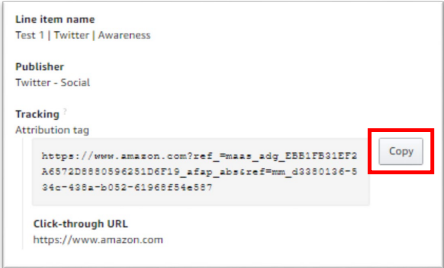
Amazon Attribution uses tags placed in external ad URLs to measure how non-Amazon campaigns drive shopping activity and sales on Amazon.
Source: Amazon
Create separate tags for each distinct tactic rather than assigning a single tag at the channel level. This improves measurement accuracy and makes ROAS comparison more reliable across tactics. Assign separate Amazon Attribution tags to prospecting and retargeting campaigns, to branded and non-branded paid search campaigns, and to creative or audience variations that support different funnel roles.
ASIN Coverage: Include all relevant promoted ASINs, not only the hero ASIN. This gives Amazon Attribution a broader view of campaign-driven revenue by capturing both direct promoted ASIN conversions and halo conversions.
For example, if a campaign is tracking promoted ASINs for a skincare serum, Amazon Attribution can also credit halo conversions for other products from the same brand, such as a cleanser or moisturizer, when the tagged campaign influences the purchase. This gives a broader view of campaign-driven revenue beyond the directly promoted ASINs.
2. Align Campaign Intent With the Amazon Attribution Model
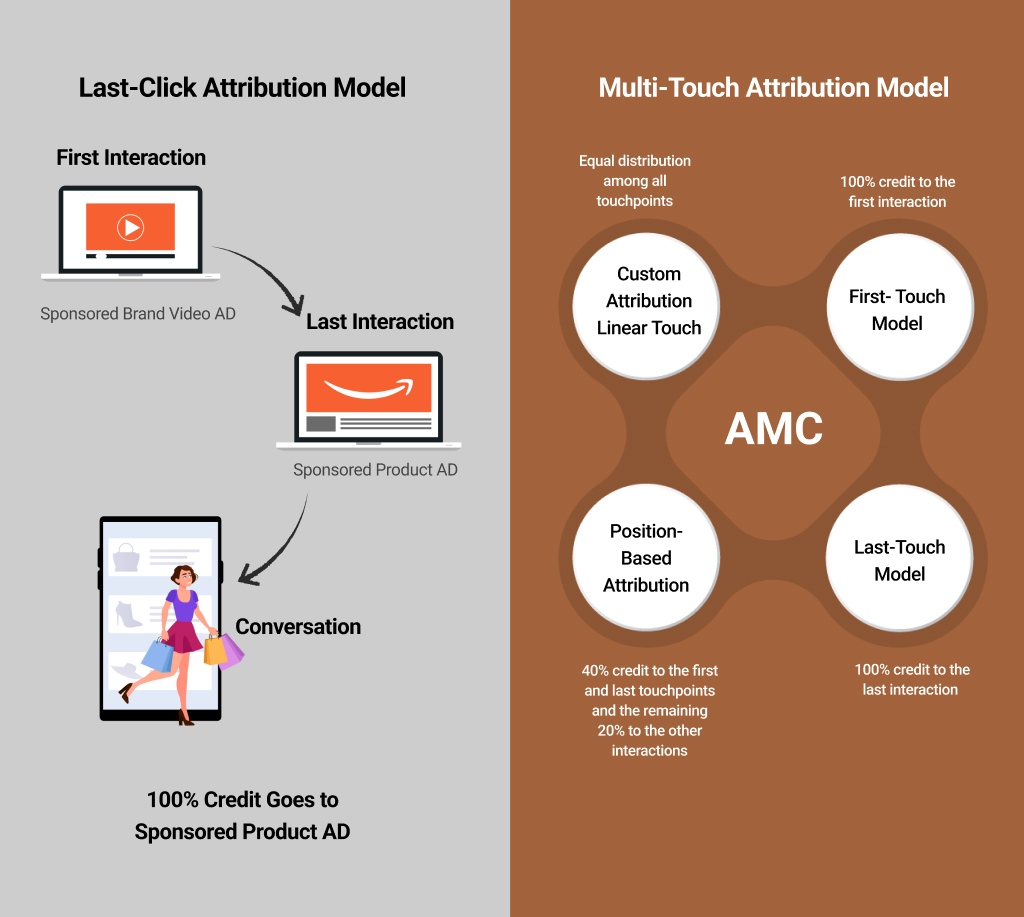
Campaign intent establishes whether the objective is awareness, consideration, or conversion, while the attribution model determines how credit is distributed across the touchpoints to support that objective. Aligning the model with the campaign intent makes measurement more relevant: first-touch for awareness, equal-weight or position-based for consideration, and last-touch for conversion-focused activity.
Awareness and New-to-Brand Acquisition — First-Touch
First-touch attribution is better suited to campaigns that initiate discovery and introduce new shoppers to the brand or product.
Conversion and Demand Capture — Last-Touch
Last-touch attribution works well for campaigns built to convert existing traffic. It is most relevant for lower-funnel activity such as retargeting, branded search, and other conversion-focused media.
Consideration and Mid-Funnel Progression — Multi-touch
When discovery, consideration, and conversion campaigns run together, a single-touch model cannot accurately represent how credit should be distributed across the journey.
Multi-touch attribution distributes conversion credit across multiple touchpoints rather than assigning it to a single interaction. The two most applicable models for mid-funnel analysis are equal-weight and position-based. Equal-weight attribution distributes credit evenly across all touchpoints. Position-based attribution weights the first and last interactions more heavily — reflecting the outsized role of initial discovery and final conversion — while distributing the remainder across mid-funnel touchpoints.
Source: SunTec India
Note: Multi-touch attribution models are available exclusively within Amazon Marketing Cloud. Amazon Attribution’s native reporting does not support configurable attribution — it operates on last-touch only.
3. Measure Performance At Every Funnel Stage
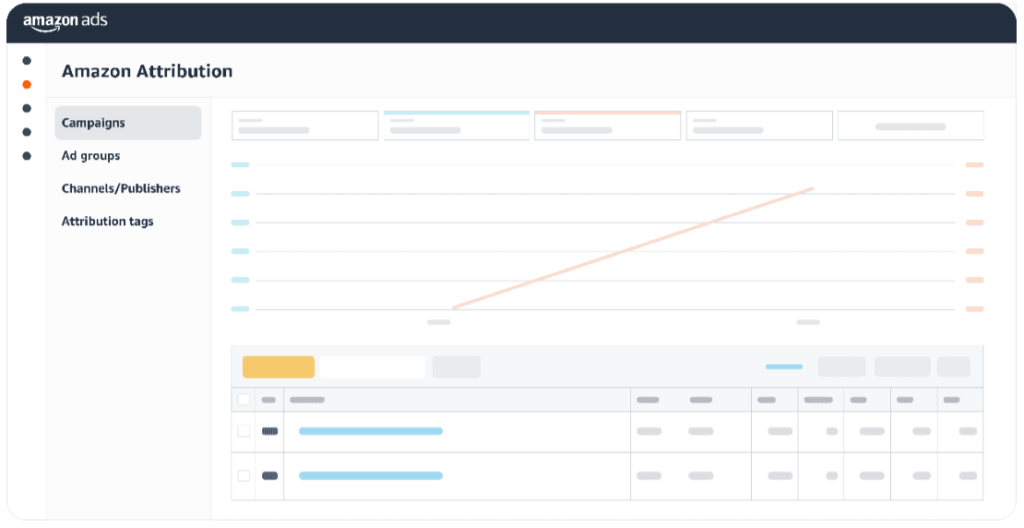
Amazon Attribution reporting maps conversion metrics to three shopper journey stages — awareness, consideration, and purchase — each tied to a distinct campaign objective. This allows Amazon PPC performance tracking to be assessed beyond the purchase event— capturing where in the consideration journey external traffic drops off before converting.
| Shopper Journey Stage | Campaign Objective | Relevant Metrics |
| Awareness | Expand brand and product visibility among new Amazon shoppers | Clicks |
| Consideration | Build purchase intent through brand and product storytelling | Detail Page Views, Add-to-Carts |
| Purchase | Stay present when shoppers are ready to buy | Purchases, Sales, Units Sold |
Source: Amazon
4. Convert Attribution Data Into Action
Apply attribution data across two areas: media allocation and listing optimization.
Media Allocation Base budget decisions on Attribution-verified ROAS, not platform-reported revenue. Meta Ads Manager and Google Ads apply their own attribution logic and consistently overstate performance relative to Amazon-recorded outcomes. Allow a minimum of 14 days of clean tag data per tactic before drawing comparisons.
Listing Optimization When a campaign drives strong DPV but weak purchase conversion, the constraint sits on the product detail page, not in the media. Address these variables first:
- Review count and recency
- Main image quality
- Price positioning relative to competing listings
- A+ Content depth
Organic Rank External traffic that converts generates sales velocity — a core input into Amazon’s ranking algorithm. Attribution data identifies which external channels drive those conversions, enabling evaluation of external media investment beyond direct ROAS alone.
Amazon Attribution vs. Amazon Marketing Cloud: How They Differ
Amazon Attribution is the starting point. AMC extends it — for multi-touch model comparison, longer lookback analysis, and conversion path evaluation across Sponsored Ads, DSP, and first-party data.
| Amazon Attribution | Amazon Marketing Cloud | |
| Primary use | Measure off-Amazon channel impact | Multi-touch model comparison and path analysis |
| Attribution models | Last-touch only | First-touch, last-touch, equal-weight, position-based |
| Lookback window | 14 days | 25 months (ad traffic), 5 years (purchase signals) |
| Access | Free, self-service | Requires an Amazon Ads account rep or certified partner |
The Business Imperative: In-house teams can manage Amazon Attribution setup. Where the gap widens is AMC — the SQL-based querying, certified partner access, and analytical capacity to run model comparisons consistently alongside day-to-day campaign operations. That is the layer that most in-house teams cannot sustain without dedicated resourcing. An Amazon PPC advertising agency delivers certified AMC access, field-level attribution expertise, and scalable resources to operationalize attribution at scale.
Author Bio –
Eliana Wilson is an experienced eCommerce consultant at Data4eCom, a leading outsourcing agency providing end-to-end eCommerce services, with a strong background in multi-channel selling, digital marketing, and product data management. She works closely with brands and online retailers to streamline operations, enhance visibility, and scale revenue across platforms, such as Amazon, Walmart, and eBay. Her expertise spans product listing optimization, marketplace compliance, eCommerce PPC, and catalog management. Eliana regularly shares insights to help businesses overcome growth challenges and stay competitive.

