

Most ports run on a collection of disconnected systems. Finance in one platform. Inventory in another. Vessel scheduling in a third. Maintenance requests are handled through email. And somewhere in between, a spreadsheet holding everything together that only one person fully understands.
That architecture is not just inefficient. It is a risk. Every gap between systems is a point where data goes missing, decisions get delayed, and revenue leaks quietly out of the operation.
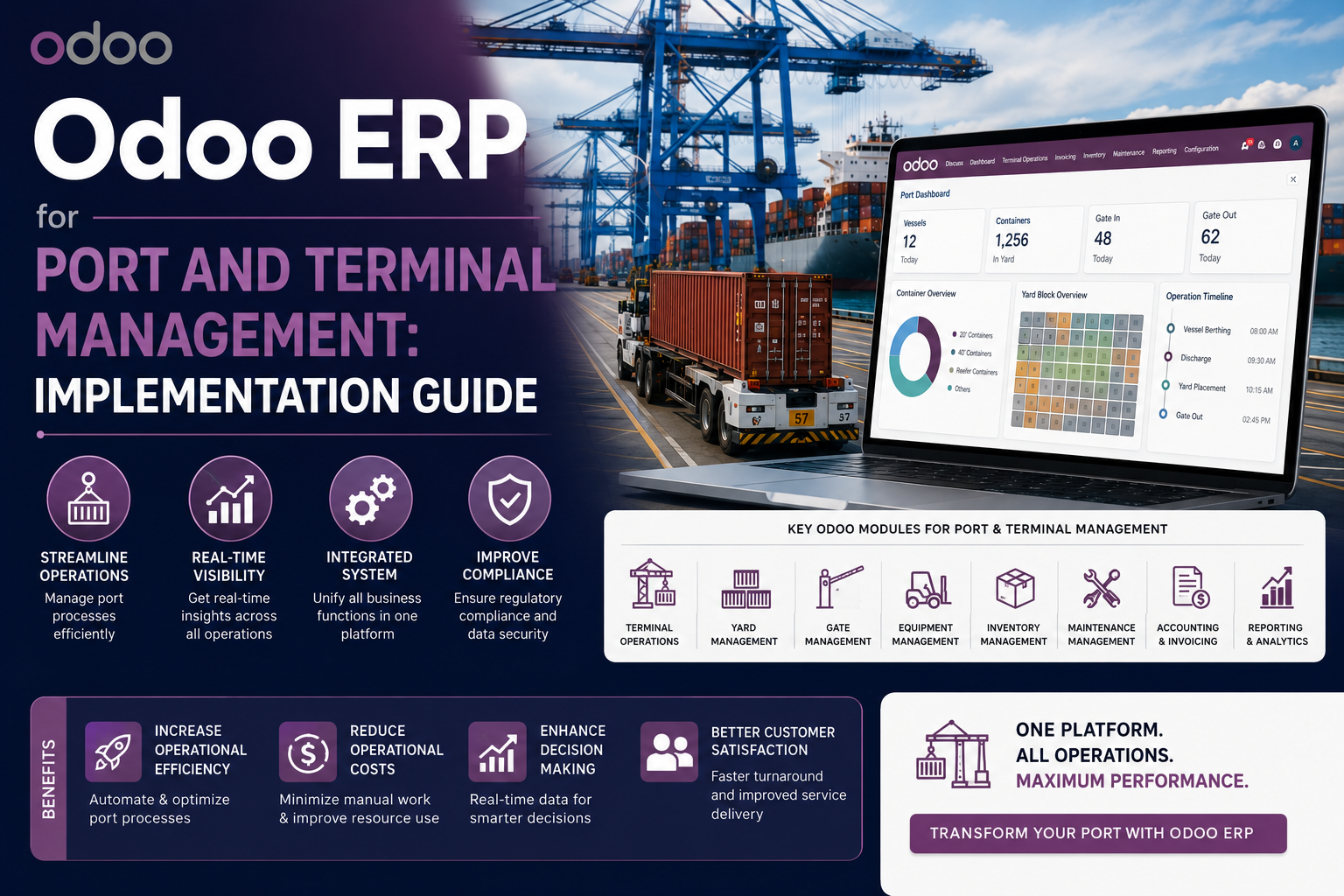
Odoo ERP implementation services offer port and terminal operators a different model: one platform, modular by design, connecting finance, inventory, procurement, maintenance, HR, and operations in a single live environment. This guide explains how that works in a port and terminal context, what the implementation path looks like, and where the real value shows up.
Why Odoo Fits the Port and Terminal Environment
Odoo is not a purpose-built port management software system in the way a Terminal Operating System is. What it is, is a modular enterprise platform that can be configured and extended to handle the operational and administrative complexity that sits around a TOS.
That distinction matters. There are already systems in place at most ports to deal with the scheduling of vessels and the movement of containers. What they are missing is the connected back office that integrates purchasing, maintenance, billing, HR and compliance without manual re-entry at each touch point.
Odoo fills that layer. And it does it at a cost that SAP and Oracle implementations rarely approach.
Here is what makes it a practical fit for port environments specifically:
| Port Requirement | Odoo Capability |
| Multi-warehouse and yard inventory control | Built-in multi-location inventory with real-time tracking |
| Equipment maintenance scheduling | Preventive and corrective maintenance modules with asset tracking |
| Vendor and procurement management | Automated purchase orders, supplier management, and landed cost allocation |
| Customs and compliance documentation | Document management with workflow automation and audit trails |
| Billing and revenue management | Automated invoicing tied to operational triggers |
| HR and shift management | Workforce scheduling, attendance, and payroll integration |
| Real-time financial reporting | Unified accounting with live operational data feeds |
The Modules That Matter Most for Port Operations
Not every Odoo module is relevant to a port deployment. A specific implementation develops around the operational core and expands outward from it.
Inventory and Warehouse Management
Manages STOCK CONTROL at multiple locations in YARD ZONES, WAREHOUSES, and BONDED AREAS. Real-time tracking and lot & serial number traceability. Enables FIFO, FEFO, and custom stock rotation rules for reefer and perishable cargo environments.
Maintenance
Carries out preventive and corrective maintenance on cranes, vehicles, conveyor systems, and port equipment. Maintenance requests are connected to asset records. Work orders are automatically activated based on usage limits or inspection schedules. The history of equipment downtime is not maintained in a separate system but linked to maintenance planning.
Purchase and Procurement
Automates vendor orders, replenishment workflows, and approval chains. Landed cost allocation distributes freight, duties, and handling fees to inventory valuations accurately, which is critical for port operators managing bonded goods.
Accounting and Invoicing
Invoices generate automatically from operational triggers, including vessel calls, storage duration, crane usage, and gate transactions, when configured against port billing rules. Revenue recognition, cost allocation, and financial reporting run from the same data environment as operations.
Project and Field Service
Manages terminal infrastructure projects, maintenance contracts, and service delivery against shipping line accounts. Timesheets and resource allocation link to financial reporting directly.
Human Resources
Shift scheduling, attendance tracking, and payroll integration for port workforces operating across 24-hour cycles. Particularly valuable for terminals managing mixed permanent and contract labor pools.
What the Implementation Path Looks Like
Odoo ERP implementation services for a port environment follow a phased sequence. Trying to deploy all modules simultaneously is the most common reason implementations run over time and budget.
Phase 1: Foundation (Weeks 1 to 6)
Goal: Get core finance, procurement, and inventory live with clean data.
This phase is unglamorous but critical. It involves mapping existing processes against Odoo’s standard workflows; identifying where customization is genuinely necessary versus where the process should adapt to the platform; migrating master data, including vendor records, asset lists, and chart of accounts; and configuring the inventory structure to reflect actual yard zones and warehouse locations.
The output of Phase 1 is a live financial and operational data foundation. Everything built on top of it depends on this being accurate.
Phase 2: Operations Layer (Weeks 6 to 14)
Goal: Connect maintenance, billing, HR, and document management to the live foundation.
Maintenance workflows go live against the asset register built in Phase 1. Invoicing rules are configured against port tariff structures. HR and shift management connect to payroll. Document management workflows handle customs paperwork, inspection records, and compliance documentation.
Phase 3: Integration and Optimization (Weeks 14 onward)
Goal: Connect Odoo to the Terminal Operating System and external stakeholder systems.
This is where freight terminal management software integration happens. Odoo connects to the TOS via API, pulling vessel call data, gate transaction records, and container movement logs to trigger billing, update inventory positions, and feed maintenance alerts. Customs platform integrations and shipping line portal connections go live in this phase.
The Integration Question Every Port Operator Needs to Answer First
Before selecting modules or setting a go-live date, port operators need clarity on one question: what systems will Odoo need to talk to, and how?
The TOS integration is the most consequential. Odoo and a TOS serve different operational layers. The TOS manages real-time container movements and equipment coordination. Odoo manages the administrative, financial, and maintenance environment around those movements. The two need to share data bidirectionally: vessel arrivals trigger purchase orders and billing records in Odoo; maintenance alerts from Odoo feed back into equipment availability planning in the TOS.
Standard integration is carried out with carrier APIs, GPS systems, third-party logistics tools and other business applications. One of the best implementation benefits of Odoo compared to monolithic ERP is its flexibility.
Customs and port community system integration is the second priority. Automated document generation and submission against customs workflows reduces processing time and compliance risk simultaneously.
Conclusion
At INTECH Creative Services, our Odoo ERP implementation services are built around port and terminal operational realities, not generic ERP deployment templates. We configure, customize, and integrate Odoo against the specific workflows of freight terminal environments, from equipment maintenance and procurement to billing automation and TOS connectivity.
Our team has delivered port management software and freight terminal management software solutions for global terminal operators, and we bring that domain knowledge into every Odoo engagement we run.
If your port is still managing operations across disconnected systems, we can show you what a connected environment looks like and build a roadmap to get you there.

